



780th Bombardment Squadron (H)
465th Bombardment Group (H)
In World War II (1943-1945) Pantanella, Italy
A Squadron is Formed
Under II Air Force General Order No. 78, dated 29 May 1943, the 465th Bombardment Group (H) was activated on 1 August 1943 at the Army Air Base, Alamogordo, New Mexico.
It consisted of Headquarters and four Squadrons: 780th, 781st, 782nd and 783rd.
This is the history of the 780th Bombardment Squadron.
Under General Orders No. 226, dated 14 Aug 1943, Capt. Olen C. Cook was assigned to the 465th Bombardment Group (H), and by VOCO 16BOTW was further assigned to the 780th Bombardment Squadron (H) as its Commanding Officer.
His original staff was as follows:
Adjutant
2nd Lt. Lawrence Leibowitz
Intelligence
Capt. Charles Davis
Operations
1st Lt. Julius G. Kubala
Supply
WOjg Seymour S. Rivner
Bombardier
2nd Lt. Emerson C. Dunning
Navigator
1st Lt. Nile T. Horne
Surgeon
1st Lt. Eldred J. Stevens
Engineering
2nd Lt. Charles R. Dannelly
Communications
2nd Lt. William E. Barnes
Technical Supply
2nd Lt. John P. Fischer
Capt. Cook, together with his staff, less his Adjutant and Supply Officer, left Tucson, Arizona, on 29 Aug 1943 for Orlando, Florida, to attend a 30-day course of tactical training at the Army Air Force School at Applied Tactics (AAFSAT). Approximately 20 percent of the enlisted key personnel accompanied these officers, this cadre being the nucleus around which the future Squadron was to be formed. While at Orlando the Squadron suffered its first casualty, when on the initial training flight Squadron Bombardier Lt. Dunning was injured, being shot in the foot by a runaway nose gun. Tactical training was completed on 26 Sept 1943 and the unit ordered back to Kearns, Utah, to commence its combat training.
Meanwhile, on 11 Sept 1943, the balance of the Squadron had been sent to Kearns, Utah, to complete its basic training and receive newly assigned personnel.
The first staff change occurred on 30 Sept 1943, when Lt. Dunning was transferred to 520th Base Headquarters and Airbase Squadron, AAB, McCook, Nebraska, being replaced as Squadron Bombardier Officer by 2nd Lt. William R. Taylor.
Under Special Order No. 4, dated 4 Oct 1943, the 465th Bombardment Group (H) was ordered to the Army Air Base, McCook, Nebraska, to begin its three phases of combat training, leaving for that field the following day.
On 10 Oct 1943, Capt. Albert L. Liggett was assigned to the Squadron and became its first Executive Officer. On that day, Capt. Edwin R. Sievers also reported as Squadron Assistant Intelligence Officer. However, five days later he was transferred to the 781st Bombardment Squadron (H), being replaced by 2nd Lt. Forrest L. Line.
On 22 Oct 1943, 2nd Lt. Leibowitz, our original Adjutant, was transferred to 1st AF, Mitchell Field, N.Y., being replaced by 1st Lt. Herbert P. Theobald.
On 28 Oct 1943, 1st Lt. Henry C. Morris was assigned to the Squadron, and assumed his duties as Squadron Ordnance Officer.
Thus as the month came to a close the Squadron was fast taking shape, and with the continued arrival of airplanes and crew members, during the month, the closing day strength showed a total of 339 officers and men.
Toward the middle of November 1943, our Group Commander, Col. Rogers, obtained on loan five B-24 Js to aid in first phase training, later returning these airplanes to the AAB, Lincoln, Nebraska. First phase ground school training was completed on 30 Nov 1943.
In these early stages of our organization continued staff changes were bound to occur. On 18 Nov 1943, Capt. Liggett was transferred to 360th Base Headquarters and Airbase Squadron, being replaced as Executive Officer by Capt. George E. Martelle. In addition to his other duties, Capt. Davis was appointed War Bonds and Insurance Officer. 2nd Lt. Ernest W. Fallentine was appointed Assistant Operations Officer. Lt. Line, in addition to his other duties, became Physical Training Officer, as well as Unit Censor. 2nd Lt. Eugene S. Schwartz joined the Squadron as Cryptographic Security Officer, as well as Assistant Unit Censor. Other staff changes included the relief of WOjg Rovner as Personnel Supply Officer, being temporarily replaced by Lt. Fischer, the appointment of 2nd Lt. Gordon Hill as Squadron Bombsight Officer and Armament Officer, and the additional duty being detailed to Lt. Line of Squadron Photographic Officer.
Additional personnel received during the month brought the closing strength figures to 62 officers and 342 enlisted men.
On 5 Dec 1943 eight combat crews arrived, bringing the Squadron up to full strength of 18 combat crews, this being the greatest number of combat crew personnel assigned to any heavy bombardment squadron up to this time.
On 1 Dec 1943, while the entire Group stood in review, the Squadron was honored with its initial decoration ceremony when S/Sgt. Lawrence H. Brouhard received the Soldiers Medal, the Air Medal and the Distinguished Flying Cross for outstanding performance in a previous combat tour of duty.
First phase flying training was completed on 5 Dec 1943. To aid in second phase flying training four additional airplanes were secured on a loan basis, making a total of nine in commission. Cold weather and extreme difficulty in obtaining parts and supplied prevented a top effort. However, the combined hours flown by these airplanes during the month reached 549.15 hours. In order to accomplish this record, maintenance crews worked long hours day and night and came in for commendation from the Squadron Commander. During the month the Engineering Section handled nine engine changes and five supercharger changes.
Our Engineering Department designed a new device for disassembling tires from rims, which proved to be labor-saving, eliminating the use of extra bulky equipment originally recommended by the Air Force.
Group navigational records indicated that our Squadron ranked first in this respect. Due to the lack of Celestial Navigator training facilities at the base, five of out navigations were sent to Geiger Field, Spokane, Washington, to complete their training. Second phase training was actually ahead of schedule.
The staff was gradually taking shape but certain changes were still being made. On 18 Dec 1943, Lt. Fischer was transferred to 465th Bombardment Group Headquarters. Lt. Dannelly temporarily assumed the duties of Tech. Supply Officer, in addition to his regular duties as Squadron Engineering Officer. On 29 Dec 1943, Lt. Kubala was promoted to the grade of Captain and transferred to 520th Base Headquarters and Airbase Squadron, being replaced as Operations Officer by Capt. Robert M. Woodward. Other staff promotions coming on the two closing days of the year included Lts. Dannelly, Barnes and Taylor, all to the grade of 1st Lieutenant, and Lt. Stevens to the grade of Captain. As the month and year ended, the Squadron strength was now 93 officers and 393 enlisted men.
On 1 Jan 1944, our Squadron Commander, Capt. Cook, was promoted to the grade of Major.
During January 1944, training activity was maintained at a high level. Inspections were numerous. High altitude formation flying was featured and the POM inspection flight proved that the Squadron and Group were ready for actual combat duty.
On 8 Jan 1944, 2nd Lt. Crockett C. Fox, Jr. was assigned to the Squadron and detailed as Personnel Equipment Officer. On this same date, 2nd Lt. Robert R. Markley, Jr. reported and was assigned as Personnel Supply Officer, relieving WOjg Rovner, who was transferred on 10 Jan
1944 to 360th Base Headquarters and Headquarters Squadron, Pueblo, Colorado. A further staff change occurred on 25 Jan 1944 when Lt. Morris, Ordnance Officer, was transferred to 465th Bombardment Group Headquarters, being replaced by 2nd Lt. Robert K. Dewhirst.
The final week in January 1944, was devoted to the issuance of new clothing to enlisted personnel. All equipment was crated, packed and labeled for overseas shipment and with the completion of final phase training the Squadron ended its stay at this air base, with a strength figure of 94 officers and 398 enlisted men.
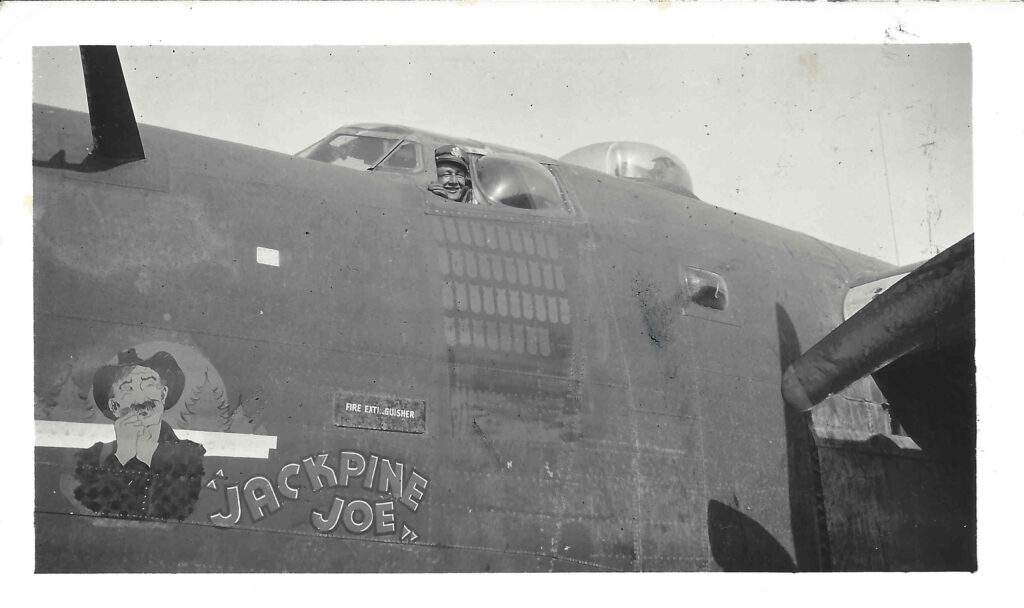
Pilot Archie Jackpine Joe
Nose art before 39th final mission
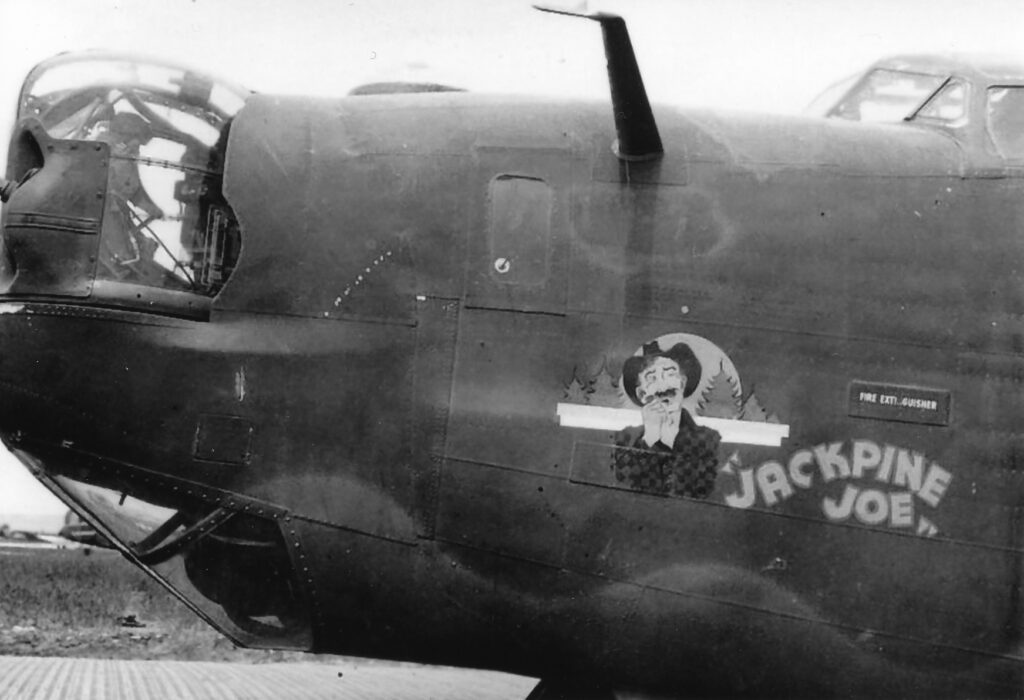
Nose art Pantatella metal runway
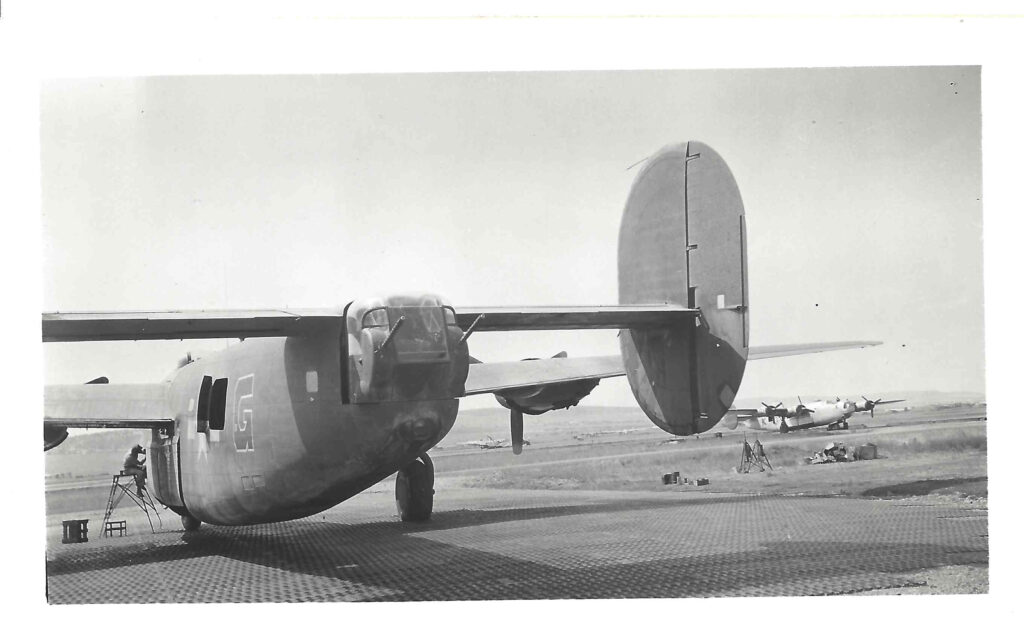
JackpineJoe Pantatella metal runway
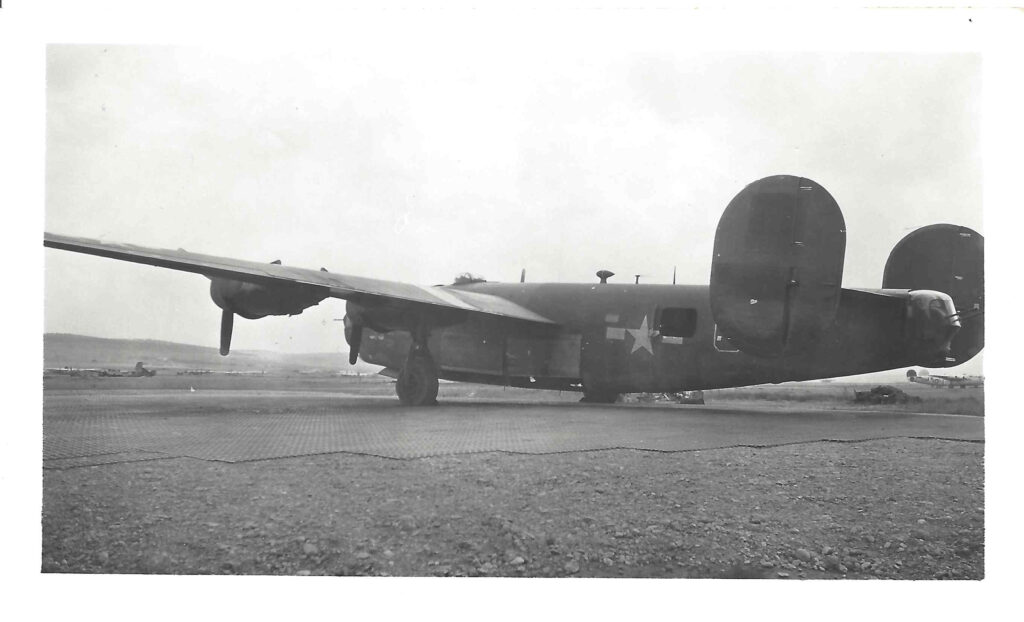
JackpineJoe Pantatella metal runway
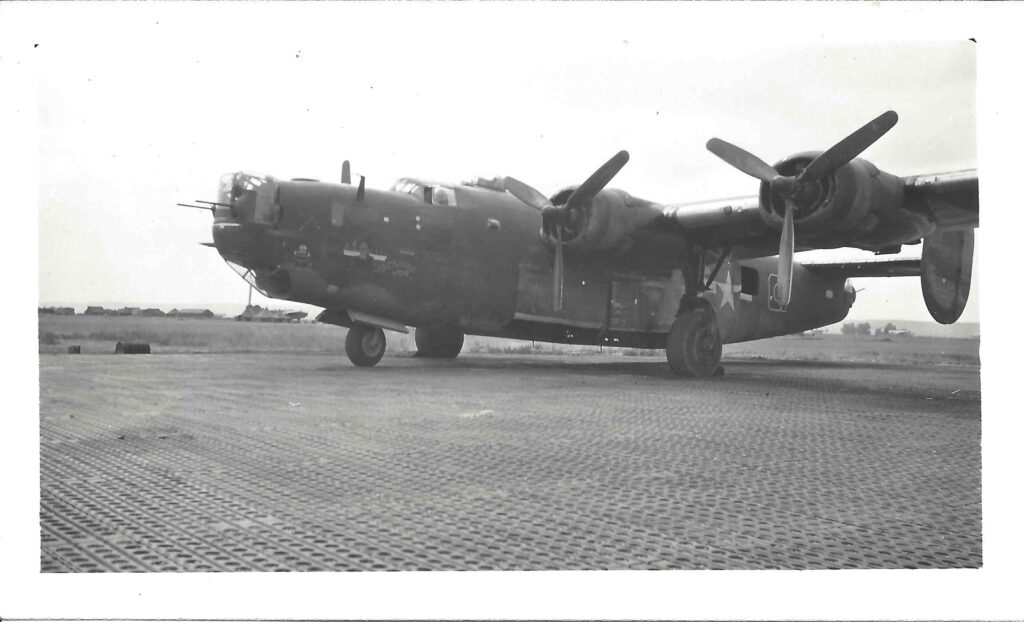
JackpineJoe Pantatella metal runway
Pilot Archie Jackpine Joe nose art
Before 39th final mission
A Squadron Moves Overseas
At 1300 hours on 1 Feb 1944, the Ground Echelon, Group Headquarters Personnel, and 4 combat crews, boarded a train at McCook, Nebraska, their destination the Staging Area at Camp Patrick Henry, Newport News, Virginia, arriving there early in the morning of 4 Feb 1944. During an eight day stay at Camp Patrick Henry final processing, physical examination, clothing and equipment checks were completed. For the first time in the history of the Squadron, mail censorship became effective.
The Squadron were given Shipment number 0622-M (Flying Echelon 0622-MZ) and were divided into two units for shipment to the Port of Embarkation, Hampton Rhodes, Va. The first unit, in charge of Capt. Martelle, was assigned to Ship No. Hr-925 (otherwise known as the “SS Lambert Cadwalader”). The other unit, in charge of Capt. Davis, was assigned to Ship No. Hr- 928 (“SS John Hathorn”), both of these vessels being Liberty (cargo) ships of approximately 10,000 tons each, fitted out to transport troops.
The first unit left Camp Patrick Henry on 11 Feb 1944, the second a day later. Both vessels departed from Hampton Rhodes, Va. On 12 Feb 1944, joining the convoy of some eighty odd vessels for final departure the following day. For most of the personnel this was their maiden ocean voyage, and with rough weather being encountered, seasickness was quite prevalent. The journey overseas was not entirely uneventful, one vessel being torpedoed, near Bizerte, Tunisia, and another vessel striking a mine in the same area, the latter vessel being able to make port, whereas the torpedoed vessel sank shortly after being attacked.
Ship HR-925, after a one-day stopover at Augusta, Sicily, reached the port of Naples, Italy on10 Mar 1944. Personnel were transferred to Staging Area No. 1 Camp at the Peninsula Base Section, departing four days later for Pantanella, Italy, where the Group Airfield was to be located. After a night stopover at Avellino, Italy, the first unit of the Squadron arrived at Pantanella 15 Mar 1944.
In the meantime, ship HR-928, with the second unit of the Squadron, was withdrawn from the convoy at Bizette, Tunisia, docking there on 6 Mar 1944. Personnel were transferred to Stagdoor Camp, remaining there until 8 Mar 1944. From there this unit journeyed by truck convoy to Phillipville, Algeria, reaching Camp Jean Staging Area (British) late in the day. Four days were spent at this camp before embarking on the “SS Illea” for Naples, Italy, as part of another sea
convoy, arriving Naples 14 Mar 1944. Personnel were then transferred to the same Staging Area as the first unit, and while at this Staging Area received their first baptism of fire when the area was bombed by the enemy late the night of their arrival.
On 18 Mar 1944, 13 officers and 77 enlisted men left by motor convoy for Pantanella, Italy, the balance of this unit – 1 officer and 79 enlisted men – remaining until 20 Mar 1944. Thus late in the day of 20 Mar 1944 the ground echelon and some few crews of the flying echelon completed the movement from McCook, Nebraska, begun on 1 Feb 1944.
The flying echelon, less the few crews which accompanied the ground echelon, on 2 Feb 1944, flying to Lincoln, Nebraska, for final processing. They arrived at Morrison Field, Florida, on 7 Feb 1944. Beginning 10 Feb 1944, departures were made for overseas, following a route which touched on Waller Field, Trinidad; Belam, Brazil; Forteleza, Brazil; Dakar, French West Africa; and Marrakech, French Morocco, with final destination Tunis, Tunisia (Oudna No. 1 Field), arrivals beginning 19 Feb 1944.
The time required to build an airfield in Italy, a matter of approximately two months, was well spent by both air and ground echelon. The latter assisted materially in the actual building of the field, including laying of the “strip” on the runways, building the area to be used by the Squadron for living quarters and generally getting the section in condition to receive the flying echelon when it arrived on the field.
Pantanella, Italy, the site of our base, lies in what can best be described as the Foggia-Bari section of Southern Italy. Canosa and Cerignola, the closest towns, were approximately 12 miles distant. Headquarters of the 55th Wing, to which the 780th was now attached; was located at Spinazzola, 20 miles distant; and the Headquarters of the Fifteenth Air Force was located at Bari, Italy, approximately 60 miles away.
On arrival at the field it was obvious that the Squadron (and Group) would have to build from the ground up. The 780th, being first on the scene, became pioneers in this building program and daily work calls for weeks to come transferred our Air Corps specialists into engineers. Tents were quickly erected. Cots were built, latrines dug, mess equipment installed and in a remarkably short space of time the field commenced to take definite shape. The weather was somewhat of a handicap during this period, Italy failing utterly to live up to its reputation as being “sunny,” all of which had a very real effect on the morale of the men.
The location of the field proved ideal, indeed. Situated high on a hill, overlooking a beautiful valley, the men found it easy to adjust themselves to their new living conditions. A short time after arrival of the personnel the weather moderated and with beautiful, warm spring days appetites became sharp and morale improved rapidly.
Taking full advantage of this additional time, the flying echelon, based at Oudna Field, near Tunis, engaged in an intensive schedule of combat training, consisting principally of high- altitude formation flying, bombing and gunnery. It is doubtful if any group of combat personnel
could be sent into combat better trained, and it augured well for a good record for the Squadron. On 19 Apr 1944, the flying echelon left Tunis for Pantanella and thus finally the entire 780th Squadron, with both flying and ground echelons, were at last together as one working unit, fit and ready for whatever the future would require.
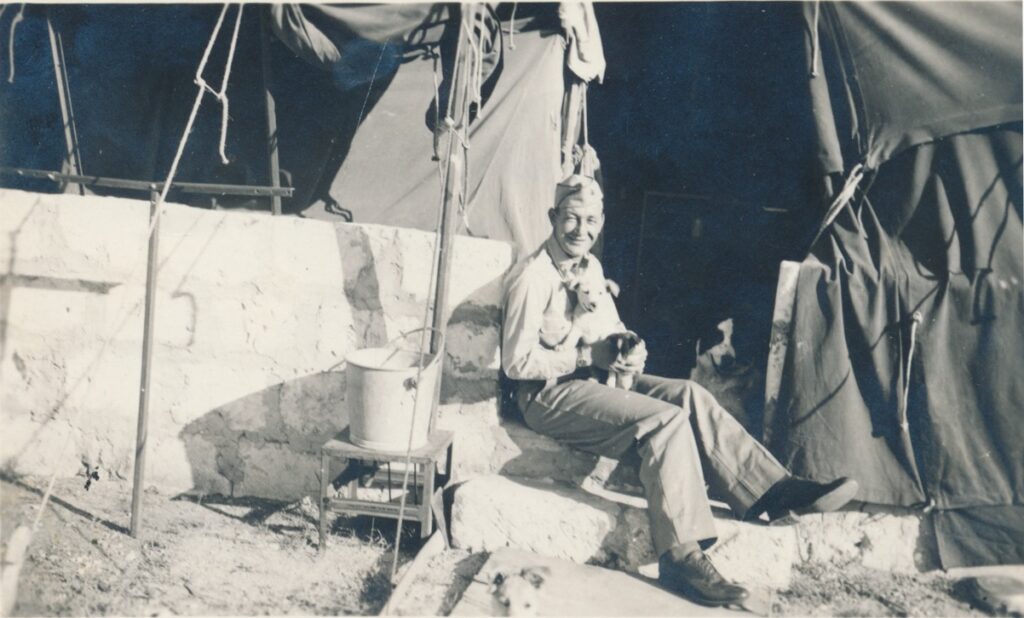
1944 ITALY Archie Davis
A Squadron Goes into Combat
With the approach of May Day 1944, there was but one thought in the minds of all members of the Squadron – when would the Squadron become operative; when would it actually become a combat organization? Only a few days were required to answer this question, for on 5 May 1944 the announcement was made that the “freshman” mission was scheduled. Excitement, together with a feeling of confidence, prevailed throughout. The personnel were well trained and as fit as human hands could possibly make them. On this epochal mission the target was Podgorica, Italy, and ten aircraft from our Squadron were dispatched. The mission proved so successful that General Twining, commanding the Fifteenth Air Force, issued these words of commendation: “It was the finest freshman mission ever flown in the Fifteenth Air Force.”
Once under way in the field of combat the Group and Squadron flew a total of 18 combat missions in the 26 remaining days of the month, 9 of these missions during the final ten days of the month, a tribute indeed to the skill and stamina of the combat crew personnel. Many commendatory messages were received during this period from higher commanders as a result of the fine bombing record being compiled by the Group in its initial month of combat. As a matter of interest, the Group flew a total of 15 combat missions without the loss of a single airplane and with but slight injury to two of its personnel. The Squadron completed all 18 of its missions during the month without a casualty of any kind to personnel or equipment, a rare feat in itself.
During the month work continued in the building of the area. Construction of the Officers’ Mess building got under way in earnest. The foundation for the Enlisted Men’s Day Room was laid and it was hoped that these two structures would be completed in a very short time.
On 8 May, Capt. Martelle was relieved of his duties as Executive Officer. Lt. Carr, who had previously relieved Lt. Theobald as Squadron Adjutant, temporarily added the duties of Executive Officer to those of Adjutant, Capt. Davis being called in to assist during this period.
Visits of higher commanding officers included those of Major General Twining of the Fifteenth Air Force and Colonel Acheson of the 55th Bombardment Wing, both expressing pleasure at the fine record being established as well as the appearance of the airfield and Squadron quarters.
Necessary precautions were taken to minimize the possibilities of malaria, so prevalent in that section during the summer months. Mosquito “bars” were installed in all tents, atabrine tablets issued at all evening meals and extra precautions taken to provide for the highest degree of sanitation throughout the area. Showers had been installed, no small achievement of itself under the conditions. To add to the fine morale of the personnel the month witnessed an unusually
large number of promotions, especially in the enlisted grades where the Squadron was rapidly attaining its full T/O strength.
During June 1944, 17 combat missions were flown by combat personnel of the Squadron. These, together with the 18 flown in May, totaled 35 combat missions flown without a casualty of any kind to equipment or personnel. It was an amazing performance, to say the least, and as our combat crews continued to piple up mission after mission without loss of any kind, interest throughout the entire Squadron grew in intensity and overshadowed every other activity on the field.
Our gunners were not idle, accounting for 13 enemy aircraft during the month of June.
As a reward for the excellent performance of the Squadron, rest camp leaves and furloughs were given to the Isle of Capri, Village Mancuso (a beautiful mountain resort in Southern Italy) and San Spirito (a seaside resort near Bari, Italy, on the Adriatic). Shortly after the capture of Rome it was possible to open this historic city to visits of the armed forces, the honor of being first from the Squadron to receive such a leave going to 1st. Lt. Archie C. Davis. In addition to these leaves and furloughs parties of officers and men were sent daily by truck to beaches near Barletta, Italy.
On 17 June 1944, the beautiful Officers’ Club and Mess building was completed and formally opened. This was the occasion for a real celebration, an excellent orchestra from the 456th Bombardment Group being engaged. Invitations to attend were extended throughout the Group and a large number of visitors honored the Squadron officers by being present. (Due credit for the unusually fine decorations belongs to Lt. Archie C. Davis, T/Sgt. William J. Llewellyn and S/Sgt. James J. Thomas.) The day following the opening found the Squadron officers dining in an atmosphere scarcely believed possible under field conditions.
The Enlisted Men’s Day Room continued to progress satisfactorily. Work was rushed on this building and before the month ended it was sufficiently completed to permit a “preview” in the form of an old-fashioned “beer bust,” together with a surprise “jam” session by members of the 456th Bombardment Group Orchestra, who came over from the Officers’ Club where they had been furnishing the music for the initial officer’s dance, made possible by the graciousness of Army nurses from the nearby 4th Field Hospital and the 26th General Hospital at Bari, Italy.
Continued attention was paid during the month to sanitation, particularly to minimize dangers of dysentery during the summer months. Construction of screens for all mess building doors and windows, as well as further improving inspectors from higher headquarters who visited the area. A visit of the Red Cross Clubmobile girls with their mobile unit dispensing coffee, lemonade and doughnuts received the unanimous approval of all personnel, demanding an early “encore.”
Probably the luckiest person in the entire Squadron was deemed to be Lt. Edgar J. Trott. He was selected to return to the United States for a 6 weeks’ course in gunnery, followed by a 21 day leave, all of which followed his promotion a few days previously to 1st Lieutenant.Page 7 of 25
On 16 June 1944, the Squadron received its first combat crew replacement, 4 officers and 4 enlisted men arriving, followed by 2 additional enlisted men on 30 June 1944.
During July 1944, the Squadron flew 19 effective combat missions for a total of 54 since becoming operative on 5 May 1944. For over half the month the phenomenal record continued – Lt. Biddle and Sgt. Greer – received injuries requiring their removal to hospitals. Thus to Lt. Biddle went the doubtful honor of becoming the first combat casualty of the Squadron.
On 19 July 1944, flying on its 47th mission, the fine record established by the Squadron came to an end. On this mission, the objective being the bombing of the Allach Aircraft Factory near Munich, Germany, the airplane piloted by Lt. Archie C. Davis failed to return. Later information revealed that all members of the crew with the exception of Lt. Ballach (killed) bailed out successfully and were interned in Switzerland. Thus the Squadron established a record of flying 46 consecutive combat missions without the loss of a single person or piece of equipment, a record that will live long in the memories of each and every member of the Squadron and one which, when the history of the Air Force is finally written, will undoubtedly be considered one of the outstanding performances of the war itself. Many of the missions flown were over targets heavily defended and in the face of severe fighter opposition. It was not all a matter of luck that such a fine record was established, but rather a tribute to the superior quality of flying of our combat crew members, the high standard of airplane maintenance of our ground crews, and the excellent fighter protection we received on all our missions.
It may be of interest to not that during the period 5 May to 19 July 1944 the airplanes of the Squadron flew a total of 395 effective combat sorties. Prior to becoming operational, the Squadron flew a total of 826 training sorties at McCook, Nebraska, including the overseas flight to North Africa, as well as as additional 303 training sorties in North Africa, for a grand total of 1,524 sorties flown since activation of the Squadron, without the loss of a single airplane or person.
Three days after losing our first airplane, on 22 July 1944, flying its 49th effective combat mission, the airplane piloted by Lt. Duncan ran out of gasoline just short of the field, the entire crew bailing out safely near Canosa, Italy, injuring Lt. Huff, S/Sgts. Krofft and Carpino.
On 26 July 1944, while on a mission to bomb targets at Vienna, Austria, Lt. Godfrey and his crew failed to return. Later information revealed that Lt. Godfrey and his co-pilot, Lt. Hooper, were killed in attempting to crash land the airplane while the remainder of the crew bailed out safely. Thus we finished our third month in combat with losses – two crews and three airplanes.
Again our gunners were active during July, receiving official credit for 14 enemy aircraft.
The quota of officers and men eligible for rest camp leaves and furloughs was increased during the month. With the approach of warm weather, swimming at the nearby beaches fronting the blue Adriatic continued a popular diversion, particularly on “stand down” days and, despite many operating obstacles, our showers provided quick relief from the warm weather to those
remaining on the field. Both Officers’ and Enlisted Men’s clubs were now operating on a regular basis and were the source of many interesting parties and gatherings. The fine health of the Squadron personnel continued to reflect the many precautionary measures taken to guard the men against the usual diseases so prevalent in that section of Italy during the summer months. A notable staff change occurred on 20 July 1944 when Capt. Davis was relieved as Squadron Intelligence Officer to take over the duties of Squadron Executive Officer. Another and important addition to the staff occurred late in June with the selection of Capt. Wm. K. Zewadski to fill the vacancy of Squadron Operations Officer, vice Capt. Woodward, relieved. During the month personnel were given an opportunity to visit Bari, Italy, and witness the presentation of Irving Berlin’s famous “This is the Army” show.
As the month came to a close word came that a cadre of ground personnel was being formed to return ro the United States to become part of a B-29 organization being assembled. The quota from the Squadron was set at 13, the “lucky 13” selected follow:
M/Sgt. Wm. E. Yeager
T/Sgt. Jos. A. Flory
T/Sgt. John P. Shephard
S/Sgt. Sebron L. Howard
Sgt. Francis L. Waters
Sgt. Charles F. Dodge
Sgt. Charles D. Hadsell
Sgt. Andrew V. Anderson
S/Sgt. John A. Sokody
Cpl. Lawrence E Nis
Cpl, Adolf U. Hankala
Cpl. James M. Summers
Cpl. Alvie O. Gibson
All these men were experts in their respective specialties and the best wishes of the entire Squadron went with them.
Squadron strength at the end of July 1944 was 85 officers and 396 enlisted men.
August 1944 saw the Squadron reach its peak in combat activity as well as suffer its heaviest losses. A total of 21 additional missions were flown, greatest of any month since becoming operational, this making a total of 75 combat missions flown since 5 May 1944.
Six of our crews failed to return from missions, one later returning, but ironically most of the members of this crew becoming casualties later in the month when their airplane exploded in mid-air.
Here, therefore, is a list of the events of the month in order of their occurrence:
On 3 Aug 1944, while flying on a mission to bomb the Manzel Aircraft Works at Friedrichshafen, Germany, the airplanes piloted by Lts. Clarke and Crane were the victims of one quick “pass” by enemy aircraft, Lt. Clarke’s plane being out of control, with one engine feathered; while Lt. Crane’s plane was last seen in the same area, with wheels down, under control, with an undetermined number of men attempting to bail out to safety. On this same dayPage 9 of 25
Gunner Sgt. Miguel M. Garcia accounted for three enemy aircraft in a very short space of time, winning the Distinguished Flying Cross for this rare feat.
On 7 Aug 1944, Capt. Zewadski and his crew, on a mission to bomb Blechhammer, Germany, were unable to return to the base but managed to land safely in Lwow, Poland, returning to the base nine days later.
On 16 Aug 1944, Lt. Secor and his crew failed to return from a mission to bomb Friedrichshafen, Germany. He was last seen with one engine feathered, after having called in to say that he was heading for Switzerland, where it was believed he made a safe landing.
With few exceptions the personnel from all these planes were later returned to military control.
Our final and heaviest losses in the history of the Squadron were suffered on 24 Aug 1944, when on a mission to bomb the Fanto Oil Refinery at Pardubice, Czechoslovaka, the airplanes piloted by Lts. Lengvenis and Buck failed to return – Lt. Lengvenis’ plane having a wing shot off and then exploded in mid-air, killing the entire crew, while Lt. Buck’s plane made a forced landing in the Adriatic Sea after running out of fuel, F/O Nolan, after a harrowing experience in the sea, being the lone survivor. It was the crew of Lt. Lengvenis’ plane that had accompanied Capt. Zewadski on the mission of 7 Aug 1944 and was unable to return to the base until 9 days after this mission.
As a partial offset to our losses during the month our gunners accounted for 10 enemy aircraft, including on ME-109 destroyed by 2nd Lt. William F. Stephens on 24 Aug 1944, he being the first and only officer in the Squadron to receive such credit.
The Squadron was fast assuming veteran standing, as witness, personnel were completing their tour of duty and being returned to the United States for rest, rehabilitation and reassignment. First in the Squadron thus to finish was Lt. Draper on 3 Aug 1944, followed by S/Sgt. Shoemaker on 6 Aug 1944. However, after this man left for rest camp one of his missions was ruled “incomplete,” necessitating his flying one additional mission – before which time T/Sgt. Brouhard, completing his second combat tour of duty, finished his “fifty” on 13 Aug 1944 to become the first enlisted man in the Squadron to finish his current tour of duty.
On 11 Aug 1944, the Squadron was honored by being selected to receive the history-making airplane “V-Grand” the 5,000th B-24 Liberator bomber manufactured by the San Diego, California plant of the Consolidated Aircraft Corporation. This airplane had already received wide publicity in the United States prior to being flown overseas.
On 13 Aug 1944, the “Lucky 13” ground crew members selected to return to the United States to join a newly organized B-29 organization left the field.
Not to be outdone with all the historical occurrences of the month, Myrtle, Squadron mascot, gave birth to seven puppies, thereby presenting somewhat of a problem as to their care and maintenance.
Among the promotions which occurred during the month were those of our Commanding Officer, Major Cook, to Lieutenant Colonel; Capt. Zewadski, Operations Officer, to Major; and Lt. Carr, our Adjutant, to Captain.
On 21 Aug 1944 Lt. Fox, Personnel Equipment Officer, was transferred to 464th Bombardment Group Headquarters, being replaced by Lt. Williamson.
It is to be noted that from the 12 to 15 Aug 1944 (inclusive) the Squadron, together with Group, Wing and Air Force, participated in several missions in direct support of the successful invasion of Southern France. Another mission of interest occurred when on 18 Aug 1944 the target was again Ploesti, Rumania, main source of Hitler’s oil supply. This – the 65th mission flown by the Squadron – proved to be the final bombing of this vital target, as shortly thereafter Ploesti fell to the successful drive of the mighty Russian steam roller, thus eliminating one of the highest priority targets on the program of the Air Force. As Aug 1944 ended, the Squadron strength figures read: Officers, 91; Enlisted Men, 408.
A total of 13 combat missions were flown during the month of Sept 1944, bringing to a total of 88 the number of missions flown since becoming operational. The 85th mission – 20 Sept 1944, over Hatvan, Hungary – produced the finest bombing score yet attained by the Group, 97 percent within a 1,000-foot circle.
On his 50th and final mission, Capt. Blackburn and his crew, flying over Vienna, Austria, on 10 Sep 1944, failed to return. On the next day, flying over Munich, Germany, Lt. Depp and his crew also failed to return. Capt. Blackburn’s airplane was hit by enemy anti-aircraft fire. It first went into a steep climb with bomb bays burning. While climbing, 4 persons were seen to leave the plane. Suddenly the plane went into a spin with all 4 engines still running. It is possible that other men left the plane before it crashed. (Taken from report of eye-witness.)
Reports brought back on Lt. Depp’s airplane indicated that 2 engines were smoking before it went over the target, but that the smoke had subsided and the plane went over the target successfully. However, on the return, while the formation was passing over the Alps, it began losing altitude and falling behind the formation. After leaving the formation the plane was following the valleys of the mountains below the peaks and it appeared to be under control. Since the plane was not apparently hit by “flak” nor had it been attacked by enemy fighters, its inability to stay in formation was probably due to engine trouble and it is quite possible, therefore, that the pilot was able to bring this plane to a safe landing area.
Noteworthy during the month were some of the awards made, as follows:
S/Sgt. Miguel M. Garcia was the first member of the Squadron to receive 5 Oak Leaf Clusters (or 1 Silver Cluster) to the Air Medal.
Capt. Robert H. Morrison was the first member to receive an Oak Leaf Cluster to the Distinguished Flying Cross.Page 11 of 25
T/Sgt. Fred L. Boling, Jr. was the first member to receive the award of the Bronze Star Medal.
A medical officer received an Air Medal. Our own Capt. Eldred J. Stevens was so decorated, having completed 5 combat missions.
To further indicate the veteran proportions to which the Squadron was now running, 108 officers and enlisted men completed their combat tour of duty during the month, being subsequently transferred to the 7th Replacement Depot at Naples, Italy awaiting shipment back to the United States.
Airplane “Red H”, otherwise and more fondly known as “Agony Wagon,” (Shades of “Marcellus”) became the veteran airplane of the Squadron and Grouop by successfully completing its 60th combat mission over enemy territory. As the month ended, the Squadron strength was 83 officers and 381 enlisted men.
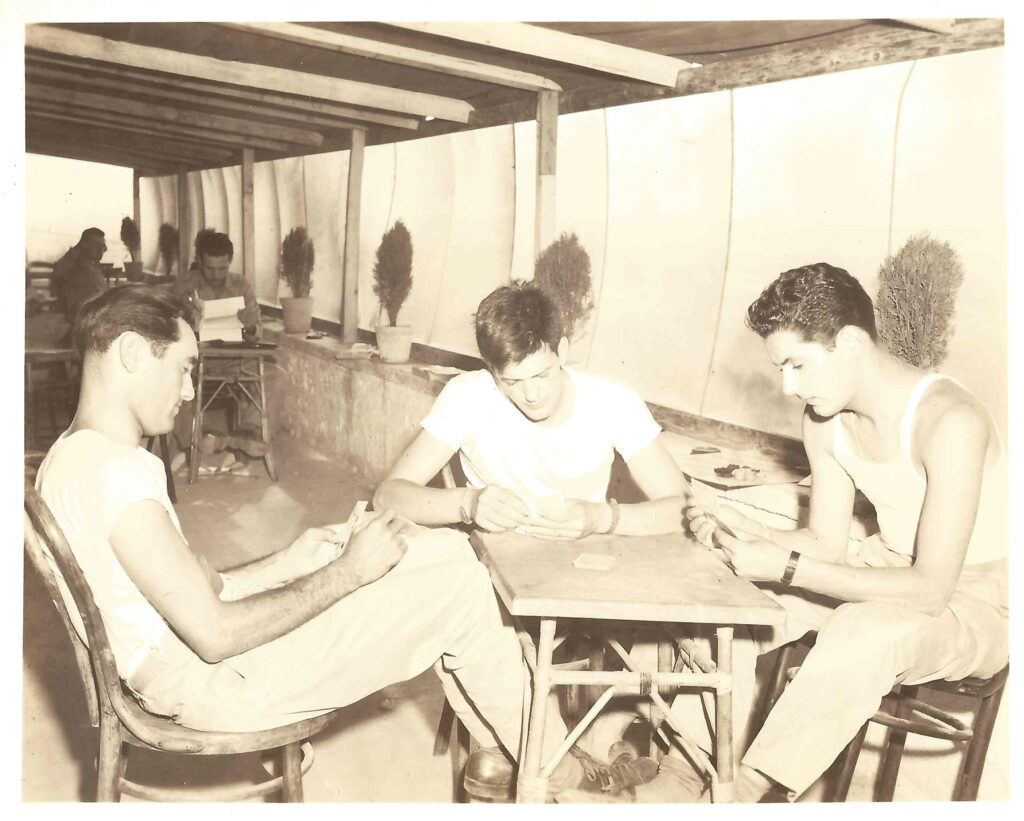
Sonny Golden Panatella and other stops 5
Pending info
A Squadron Graduates
October 1944 saw virtually a complete turnover in personnel of combat crew members. During the month 93 new members arrived from the United States to take over. It was their heritage to carry on the splendid record and traditions which made this one of the outstanding heavy bombardment squadrons of World War II. An intensive training program was set up to give these new men the necessary experience and confidence to carry on the task.
With the full realization that the Squadron was destined to spend the winter in Pantanella, winterization plans were started. Tuffi-blocks by the thousands were hauled; lime, sand, cement and other building materials were “procured.” “Ligne,” as the natives called lumber, was virtually non-existent in Italy, so all winterization materials centered around the native-mined tuffi, a sand-like substance cut from pits nearby. Some of the more fortunate, who could procure rooking materials, had small homes in process of completion as the month neared its close, while for most, tuffi-rock walls were added to tents which, with the addition of wooden or cement floors and “home-made stoves, spelled “comfort” for the approaching colder weather. With good weather continuing it seemed certain that the building program would be completed before the wintry blasts set in in earnest.
Bad weather over target areas permitted only 9 combat missions to be flown during October 1944, the fewest number for any month since becoming operational. No fighter opposition whatever was encountered, indicating how utterly impotent the once-famed Luftwaffe had become. Oil was Hitler’s greatest need and it was being denied him to such an extent that the lack of it was slowly but surely losing the war for him. The continual hammering of Ploesti and the synthetic pol plants of the Reich was at last beginning to stifle all his mechanized equipment.
During the month three combat crew members previously reported missing in action returned to the field, en route to the United States. Quite proper the first to become missing in action was the first to return – Lt. Archie C. Davis, who visited the Squadron on 23 Oct 1944. Two days
later S/Sgts. Robert A. Cook and Lawrence C. Meyers also put in an appearance. Lt. Davis failed to return from the mission of 19 July 1944, whereas the two enlisted men were missing since 16 Aug 1944. All had landed safely in Switzerland, were interned and escaped rather than permanently accept the hospitality of this neutral country.
The month was not without loss, the airplane piloted by Lt. Richard C. Klug failing to return from mission of 11 Oct 1944; target, Vienna, Austria. Reports brought back that this plane received a direct hit from “flak,” which caused the bomb bay to burst into flame. Accounts from various witnesses indicated that from 3 to 9 men were believed to have left the plane before it disintegrated. On the same mission the airplane piloted by Lt. Everett Steiner was hit by “flak” and while it returned safely to the field, the navigator and bombardier, Lts. Eugene C Zarek and Alvin G. Hyman bailed out over the target, becoming missing in action thereafter.
On 13 Oct 1944, while flying on a mission to bomb Blechhammer, Germany, the airplane piloted by Lt. John T. McWhorter was unable to return to its base, subsequently landing at Lwow, Poland, and later returning the crew to its base.
Lt. Edgar A. Trott returned to the Squadron on 18 Oct 1944, after attending the Flexible Gunnery School in the United States, he thereby being the first member of the Squadron to make the round trip since the Squadron entered the theatre of operation.
A word about “Five Grand.” On 16 Oct 1944, after flying just ten combat missions in the Squadron, this airplane was transferred to the XVAF Service Command. This airplane had a checkered career during its short stay in the Squadron. It was a sturdy plane, being able to “take it” as well as “dish it out.” During its ten missions she weathered the heaviest “flak” but always managed to return from missions despite engines shot out and other battle damage. On one occasion, for example, she lost two engines on one side yet was able to hold altitude and though forced to leave the protection of the formation managed to return to the emergency landing field at Vis, an island off the coast of Yugoslavia, clearing the Alps easily. As October 1944 came to a close, the Squadron strength was up to 102 officers, 422 enlisted men.
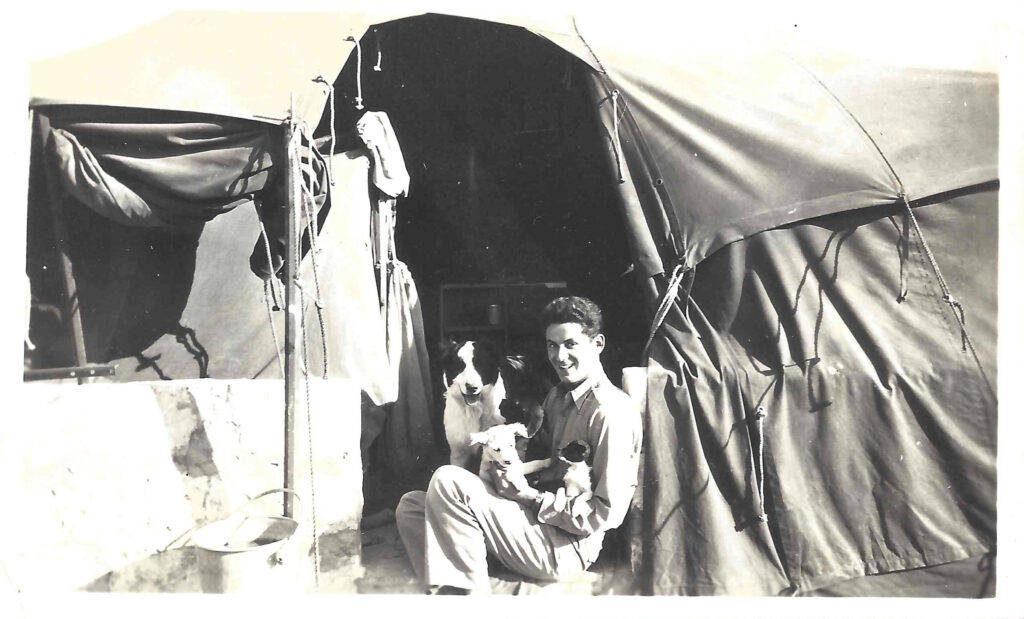
Sonny Golden Panatella and other stops 1
Pending info
New Personnel Carry On
Fifteen missions were flown during the month of November 1944 bringing the toal figure to 112 since entering combat.
Three losses during the month were recorded. On the mission of 20 Nov 1944 – target, Blechhammer, Germany – the airplanes piloted by Lts. Norman and Ord A. Campbell failed to return. Eye-witnesses reported that shortly after leaving the target area Lt. Norman’s airplane started to peel off, losing altitude rapidly. Thereafter it leveled off and kept flying on a direct course in the direction of Russian held territory. Later reports indicated that it made this friendly territory safely on three engines, the fourth smoking badly but not feathered.
On this same mission the airplane piloted by Lt. Campbell ran out of gasoline just at the spur of the Italian boot, between Viesta and Peschici. Badly damaged, and flying with two engines out, Lt. Campbell ordered the crew to bail out at 800 feet, nearing the coast. Lt. Bernstein, F/O Ryan and Sgt. Cohen landed in the water, Lt. Bernstein’s ‘chute failing to open. His body was recovered by F/O Ryan and sent to Bari, Italy for burial. The balance of the crew landed safely within 500 yards of the shore. Sgt. Thompson was injured on landing and sent to the 61st Station Hospital at Foggia, Italy. F/O Ryan was treated for shock and exposure before returning to the field.
On the mission of 22 Nov 1944 – target, Munich, Germany – the airplane piloted by Lt. Priddy, Jr. left the formation just prior to bombing the alternate target – Salzburg, Germany. Before reaching the target it was seen to drop back and was lost from sight in the undercast. Engine trouble, undoubtedly, was the cause, as the formation had not run into “flak” of any consequence up to that time.
For the third consecutive month, no enemy aircraft were encountered. A new combat technique was developed and tested during the month. Due to the seasonal weather it was becoming increasingly difficult to assemble and route a formation of bombers to any of the current targets. Rather than permit weather conditions to afford the enemy any respite, the Air Force made plans to send single airplanes, unprotected, whenever cloud cover or darkness would not permit the tactical use of formations.
Two volunteer crews from each Squadron were assigned the status of Night and Weather Crews. Our original crews were those headed by Lts. Senser and Priddy. Training consisted of night take-offs and landings, actual instrument practice, orientation in the radio and visual aids to night navigation available in this theatre of operations. In preparation for the time when radar would be the only contact with the target, the bombardier and “mickeys” practiced day runs on cities in the local area which, from the standpoint of radar, compared to the future targets in Germany and other enemy territory.
The two crews devoted the greater part of their combat time to these training missions. Briefing covered the possibility of meeting night fighters and “flak,” stressing the protection of cloud cover from both. Being alone on the bombing run, the pilots would enjoy an unlimited use of evasive action. Probably the greatest single source of danger would be icing in the cloud cover necessary for protection from searchlights and enemy aircraft.
From the date of its inception this type of bombing had been considered a success, not in itself perhaps but in the way it should compliment the tactical use of formations. Though the tonnage of bombs carried by lone bombing airplanes was naturally limited, their value in terms of damage to enemy morale was immeasurable. Interruption of enemy wartime activity would now occur at any time around the clock.
A staff change occurred when 2nd Lt. Oliver H. Saucke was appointed Personnel Equipment Officer on 5 Nov 1944, vice Lt. Williamson, relieved.
On 14 Nov 1944, notification was received that combat squadron personnel would be increased by the addition of 12 crews, bringing the newly authorized strength to 114 officers and 426 enlisted men.
Returning from internment in Switzerland during the month were the following: Lts. Secor, Moore and Friedman and Sgt. Weber. Word came that Capt. Blackburn, who had been shot down on the mission on 10 Sept 1944, was a prisoner of war in Germany, the same information being received on the entire crew of Lt. Godfrey, with the exception of him and his co-pilot, Lt. Hooper, both of whom later information revealed were killed.
Squadron strength at month end: Officers, 90; enlisted men, 413.
December 1944 witnessed the completion of an additional 17 combat missions, bringing the total to 129. Three crews failed to return – those piloted by Lts. Franklin and Withington from the mission of 2 Dec – target, Blechhammer, Germany; and the crew headed by Lt. Larson on the mission of 11 Dec 1944 – target, Vienna, Austria. Eye-witness reports on these three airplanes follow:
Lt. Franklin’s plane: A direct hit over the target caused the bomb bays to burst into flame. Several ‘chutes were seen to open as the plane lost altitude before disappearing in the clouds.
Lt. Withington’s plane: Received a direct hit by “flak” over the target, causing one engine to smoke excessively. Plane came off the target with the formation, one engine feathered and losing some altitude, but managed to stay with the formation and under control. However, lagging behind somewhat, the plane eventually turned off, apparently looking for a safe landing field somewhere in the vicinity of Gyor, Hungary.
Lt. Larson’s plane: Received a direct hit over the target. Plane seen to nose up, then go into a complete roll with bombs still in racks. Kept spiraling downward before being lost to view. Quite possible that members of crew were able to bail out before plane struck the ground.
The Squadron spent its first Christmas in the combat area and celebrated by featuring holiday entertainment at both clubs. The Quartermaster Corps came in for its share of commendation by providing a real holiday feast with turkey and all the trimmings. A few Christmas trees were secured to lend a bit of holiday atmosphere to the surroundings.
Just as the winterization program was completed then Squadron received an additional 21 officers and 52 enlisted men, necessitating a continuation of the program. With the increasing scarcity of materials and transportation, this presented a real problem but in a surprisingly short space of time the work was accomplished and by the close of the month most of the new personnel were comfortably quartered.
The Sixth War Loan drive which had been in progress since early November 1944, came to an end on the last of the year. A real effort was made throughout the Squadron to lead all squadrons in the Air Force in the purchase of war bonds and when the figures were all in it was found that
total cash purchases amounting to over $20,000 put the Squadron in first place and brought from General Twining, commanding the Fifteenth Air Force, a letter of commendation.
After an absence of three months the enemy managed to put some fighter opposition in the air, these being encountered on the mission of 6 Dec 1944 over Bratislava, Slovakia. As a result our gunners accounted for three ME-109s to increase their victories by that figure.
Returning to the Squadron during the month were the following: The entire crew of Lt. Norman, missing since the mission of 20 Nov 1944; Lts. Withington and Haight and S/Sgt. Weaver, missing since 2 Dec 1944, word coming from them that other members of this crew were safe; S/Sgt. Robert F. Johnston and Sgt. John A. Gidley, from internment in Switzerland, missing since 16 Aug 1944; S/Sgt. Billie D. Palmer, also returned from Switzerland, and missing since 19 July 1944; S/Sgt. Monroe E. Shepherd, missing since 16 Aug 1944; S/Sgt. David M. Holdsworth, missing since 22 Nov 1944. Further word revealed that in addition to Capt. Blackburn, missing since 10 Sept 1944, eight members of his crew were known to be prisoners of war. Before leaving for the United States, three of the men were prevailed upon to relate as much of their experience as security provisions would permit. Here is their story:
“We were shot up pretty badly over the target. One engine was shot out completely, one was going out slowly. We had to peel off and head for Switzerland. We didn’t know it at the time but our left landing gear was shot up, so we crash landed at Duebendorf, Switzerland. No one was hurt. We always used a ditching position on landings and it really paid off this time. When we finally hit the ground our plane was burning, so we jumped out and ran. Swiss guards ran after us with rifles, thinking we were running from them, but a B-24 with a little fire is more dangerous than a rifle. Parts of our plane were scattered all over the field. We were taken in and interrogated. Those Swiss seemed to know everything about us. We told them we were on a practice mission but they just smiled and said it was pretty realistic practice.
“Next day we were sent up to a camp in the Alps where we stayed until our escape. We had good treatment, a good bed, but the ‘chow’ was never meant for Americans and we were glad to get a good old ‘K’ ration when we got out. We got some civilian clothes and it took us about a week to escape. We traveled mostly at night, in the worst kind of weather, through woods, swamps and waded about a quarter of a mile through a river. It was no picnic getting out but it was worth it. The bad weather was a big help to us. We were able to pass guards on the frontier without being seen. We had a few scares, and often ate and slept very near to Swiss guards and officers.”
During the month four key combat personnel returned to the States – Major Zewadski, Operations Officer; Capts. Fallentine, Shae and Woodward. This left only Colonel Cook and four of his original key personnel remaining on the field. Capt. Growdon was immediately appointed Operations Officer, and Lt. Gaines, in addition to his other duties of Squadron Bombardier, was temporarily appointed Personnel Equipment Officer, vice Lt. Saucke, relieved.Page 16 of 25
On 4 Dec 1944 the Group received a Presidential Unit citation for “outstanding performance during the intensive aerial campaign against the Axis oil and communication centers,” particularly singling out the mission of 8 July 1944 when it successfully bombed the Florisdorf Oil Refinery and marshalling yards at Vienna, Austria. The citation was covered by Hq. AF General Order No. 4186, dated 26 Oct 1944. In the absence of General Twining, commanding the Air Force, Brigadier General Charles F. Born, accompanied by his staff, including Col. Charles A. Clark, Jr., our former Group Commander, made the presentation.
Included in the many promotions made during the month was the staff promotion of Capt. Davis, our Executive Officer, to Major. Squadron strength at year end was 121 officers and 478 enlisted men.
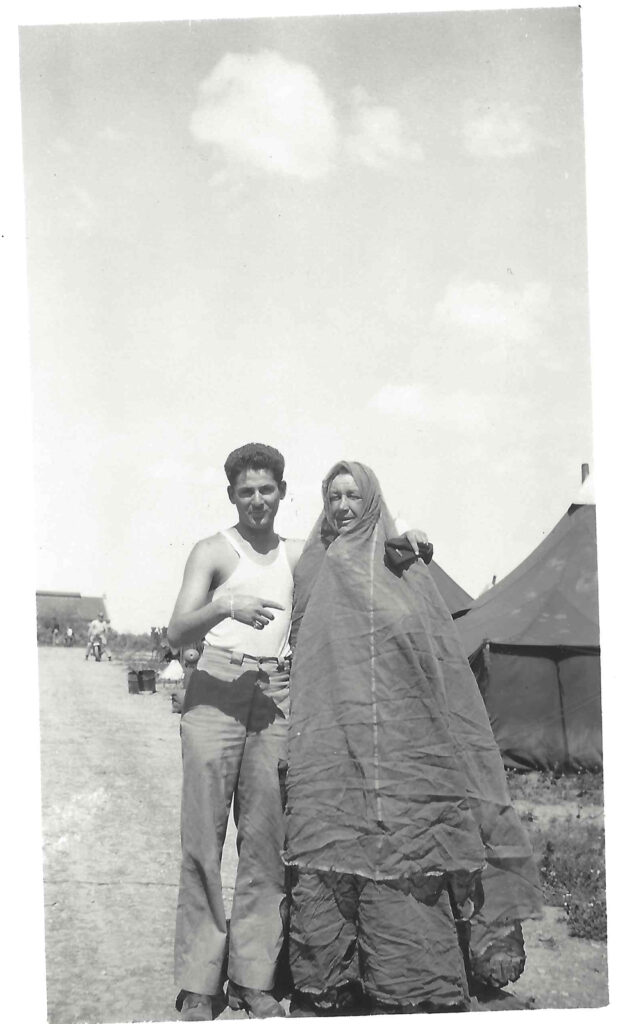
Sonny Golden Panatella and other stops 3
Pending info
1945 – The Final Year of War
January 1945 proved to be the least active month in the history of the entire Fifteenth Air Force, weather hampering aerial operations throughout the entire period. The month as a whole presented a dismal picture of snow on the ground and thick clouds over Europe, which held the Air Force to fewer operational days than in any previous month in its history. An important factor was the advance of the Allied ground forces to reduce the area subject to attack from Italian air bases. The result of this shrinkage of German-held Europe would be to increase the concentration of attacks on the part remaining. By this same token the enemy could be expected to present a heavier concentration of ground defenses at these few remaining targets.
The Squadron was able to fly only three combat missions during the month; one airplane that was piloted by Capt. Liles failing to return from the mission of 31 Jen 1945 – target, Vienna, Austria. This crew was subsequently accounted for.
It was expected that in the new year advanced bombing techniques and improved weather forecasting methods would assure maximum use of days when weather permitted operations. In addition, the development of radar would eliminate target weather as a factor in the success of a mission (except when so extremely severe as to prevent flying at heavy bomber altitude). Even when fair weather returned it was expected to play an important role because “mickey,” as this new radar device was known, could pierce clouds, smoke or darkness to reveal a target and it was well known that the enemy resorted to the intensive use of smoke screens to conceal his installations.
The new year itself was ushered in with six inches of snow. However, the Squadron area was now virtually 100 percent winterized and consequently well able to withstand the elements.
On the mission of 31 Jan 1945, the Squadron’s long-standing safety flying record was finally ended, one of the airplanes being forced ro crash land on the field, with injuries to one officer and five enlisted personnel. This was the first non-combat accident to occur since the Squadron was activated, a truly remarkable record in itself.Page 17 of 25
During the month word was received that Lt. Priddy and a few members of his crew, missing since 22 Nov 1944, were prisoners of war.
The patriarch of the field, “Red H: (“Agony Wagon”) continued to compile a fine record of missions, completing its 78th mission as the month ended. On the mission of 4 Jan 1945, it suffered a real damaging blow when an 88 mm shell penetrated the “waist,” leaving a huge gaping hole large enough for a person to crawl through. Luckily, the shell failed to explode or else the long record of this airplane would have come to an end then and there. As it was, “Agony” managed to “limp” back to the field for repairs and its splendid ground crew soon had it ready for further flying.
Two staff promotions during the month were those of 1st Lts. Hill and Gaines to Captain. An addition to the staff occurred on 24 Jan 1945 when Capt. Charles J. Thornton arrived as Squadron Intelligence Officer.
On 2 Jan 1945. The Squadron received a surprise in the return of “V-Grand,” whose obituary had already been written. This airplane had already had a stormy career in its short combat tour, but would now go back after more glory for its manufacturer before hostilities would end.
Squadron strength at month end: Officers, 126; enlisted men, 480.
The feature of the month of February 1945 was a change in Squadron commanding officers. On 27 Feb 1945, Lt. Col Cook was transferred to Hq. 15 AF, A-2 Section, Bari, Italy, being succeeded as Squadron Commander by Major Growdon, Operations Officer. The latter had only recently been promoted from the grade of Captain (8 Feb 1945). Col. Cook had been in command of the Squadron since its activation and had witnessed its growth from a handful of officers and men to a well-rounded, veteran organization of 125 officers and 489 enlisted men, including 34 complete combat crews. In leaving he could feel justly proud of the outstanding record established by the Squadron in all its training and combat operations. Major Growdon, wearer of the Air Medal and four Oak Leaf Clusters as well as the Distinguished Flying Cross, was succeeded as Operations Officer by Capt. Jennings P. Dawson.
Unlike January 1945, when but three combat missions were completed, a total of 20 missions was flown during February 1945. All planes returned safely but on the mission of 7 Feb 1945 – target, Vienna, Austria – Lt. Ostrand and T/Sgt. Gracner received injuries which necessitated their removal to a field hospital. Sgt. Garcner, incidentally, distinguished himself by courageously staying at his post of airplane engineer and, though unable to remain on his feet, directed the operation of the airplane, aiding materially in its safe return to the field.
This mission proved unusual in another respect. Eight of our Squadron became separated from the Wing formation due to complete cloud cover through which the formation was forced to fly. Forming one large “box,” it became attached to the 304th Wing, flying to another target. Approximately 50 miles from Vienna the “box” again became detached from the formation and went over Vienna alone dropping its bombs over what was probably the most heavily defended
target in the entire European theatre of operations. While the planes were pretty badly shot up, none was lost and all managed to return to the base, although considerably later than the remainder of the Group.
On 22 Feb 1945, the following personnel repatriated from internment in neutral Switzerland, visited the Squadron prior to their return to the United States: 1st Lt. Francis C. Dodd, 2nd Lt. Nathan Goldenbloom, T/Sgt. Alva H. Moss, S/Sgts. S. C. Womacks, Robert A. Wiley and Robert H. Desmond. Word was received that four more members of Lt. Priddy’s crew, missing since 22 Nov 1944, as well as four members of Lt. Franklin’s crew, missing since 2 Dec 1944, were accounted for as prisoners of war. These included: Lts. Michael J. Pollot, Modesto Pellecchia, Calvin C. Epsy, S/Sgts. George E. Crawford, Francis Josselyn, Sgts. Wm. H. Hill, Thomas L. Cremeen and Franklin K. Powers.
In addition to the departure of Col. Cook, the following key personnel left for the United States during the month: Capt. Gaines, Squadron Bombardier; Capt Horne, Squadron Navigator; they being replaced by Lt. Wm. J. Johnson and Lt. Jos. C. Stokes, respectively. With the departure of these officers Major Growdon became the last member of the original combat crews to remain with the Squadron. As a matter of fact, our first replacements were already completing their tour of duty, Lt. Peteraf being the first officer to do so, on 23 Feb 1945, followed by T/Sgt. Verner E. Gayvert, the first enlisted man to finish, on 28 Feb 1945. Verily the Squadron combat personnel was now turning over at a fairly rapid rate.
Morale remained at a high level due to the unusually fine weather experienced, the comforts in the field of a completely winterized area and the many improvements made in the messes including the addition of a steam table to say nothing of dishes replacing mess kits. Cooks were catching the spirit and the quality of meals being prepared was noticeably better.
An intensive Information-Education program in charge of Lt. Line, with assistants Sgts. Moore and Teasley, got under way, weekly discussion group meetings being held in the I-E room of the Enlisted Men’s Club building. These discussions clarified such topics as the GI Bill of Rights, Postwar America, Our Ally – Russia, the Troop Carrier Command, and many others. A sidelight on the meetings was a week spent on the subject of art, this group being led by Sgts. Yip and Thomas and revealing a surprising amount of talent in the Squadron, which resulted in the formation of an Art Club. Squadron strength at month end was: Officers, 125; enlisted men, 489.
Again, in March 1945, twenty combat missions were flown with all airplanes returning safely, heaviest concentration being on the enemy’s marshalling yards. The strategy of crippling enemy’s points of distribution was having its effect on his ability to resist the unrelenting Allied drives being made on both eastern and western fronts. Enemy aircraft opposition during the month was also absent.
The two outstanding features of the month, however, were the fall of Vienna and the loss of “Agaony Wagon,” this latter event, from a Squadron standpoint at least, coming in for more attention than the elimination of Vienna as a further target for our planes.
Page 19 of 25
In connection with the fall of Vienna it is of interest to more that on 22 March 1945, a few days before it fell, our Group bombed this target for the final time, being the last group to do so before its capture by the Russian armies. With the famed Ploesti oil fields in Rumania, Vienna was considered the most heavily defended target in all of Europe and its fall indicated the early completion of the mission of the Strategic Air Force in the European theatre of operations.
But “Agony Wagon” was gone and that was tragic. As a matter of record it was not flown by any crew of the 780th Squadron on its 92nd and final mission, but was entrusted to a freshman crew from another squadron of the Group.
Airplane B-24H 42-52376, “Red H,” but more fondly known as “Agony Wagon” (Shades of Marcellus) was assigned to the Squadron at McCook, Nebraska, on 14 Jan 1944. Including its four original engines, it had had a total of 19 engines, the average engine life (until the airplane was lost) being approximately 335 hours per engine. This was by far the highest average of any airplane in the Squadron.
On taking off on what proved to be its last mission the airplane had a total flying time of 999:25 hours, so that as it crashed it had just turned 1,000 flying hours, also the highest flying time of any airplane in the Group.
On 30 Aug 1944, No. 3 engine, with only 31:50 hours, was damaged sufficiently by “flak” to require and engine change. This was the initial engine change in the history of the Squadron for “flak” damage. Between 5 May 1944 and 6 Aug 1944, the airplane flew 44 missions without a single early return. In all, “Agony Wagon” flew a total of 92 combat missions with only 6 early returns. After her 70th mission it not only received the attention she richly deserved by Squadron personnel, but was the subject of much interest throughout the Group as each succeeding takeoff brought a correspondingly successful return. When lost it was well on its way to a record of longevity which was hoped would match anything ever done in combat for this type of airplane. To those who flew this airplane, as well as her ground crew which was instrumental in making this record possible, go full credit.
On the first mission in March 1945, flying over the alternate target of Maribor, Yugoslavia, an act of heroism was performed that is worthy of mention. The “flak” encountered was described as “heavy, very intense, extremely accurate” (“most accurate ever seen”). A few seconds after “bombs away,” the plane in which T/Sgt. Edward V. Miller, engineer, was flying received a direct hit through the bomb bays, a piece coming up through the doors to the flight deck, hitting one of Sgt. Miller’s legs and severing it. First aid was immediately rendered, just as the bomb bays caught fire. With the bomb bays badly shot up, the hydraulic system shot out, preventing the doors from being closed, danger of the airplane blowing up was great. Despite his serious condition and excruciating pain, Sgt. Miller calmly and bravely stuck to his post and when No. 3 gasoline tank ran dry, directed others on how to properly transfer fuel, aiding materially in the safe landing of the airplane on a emergency landing field. Despite his serious condition, Sgt. Miller retained consciousness and his fortitude so inspired the rest of the crew that they were able to crash land the airplane without loss to personnel. For his heroic action under such trying
conditions, Sgt. Miller was awarded the Silver Star Medal and his bed in the 26th General Hospital, Bari, Italy, became the gathering place for members of the Squadron who flocked down there to pay him homage. Lt. Blasczyk also was wounded on this same mission and removed to the hospital.
Other casualties on this mission included the death of Bombardier F/O James C. McCloskey, bit by “flak” a short time before the Airplane in which he was flying crashed landed, his body being removed by Partisans and buried in the town cemetery of Kutinica, Croatia on 2 March 1945. Other members of this crew, wounded and hospitalized, included F/O Ryan, Sgt. Millington, Jr. and Cpl. Schlossberg.
The entire crew of Capt. Liles, missing since 31 Jan 1945, returned to the Squadron during the month.
On 4 Mar 1945, Lt. Alfred W. Peteraf departed for the United States. This was an epoch in Squadron history, he being the first combat replacement member to complete his tour of duty.
On 10 Mar 1945, the first edition of a Squadron newspaper, titled “Squoop,” made its appearance. Its staff consisted of the following: Editors – S/Sgt. John M. Most, Sgts. James Moore and Lucius E. Teasley; Art Editors – T/Sgt. Charles D. Yip, S/Sgt. James J. Thomas; Feature Editor – Cpl. Jules B. DesJardins.
On 15 Mar 1945, S/Sgt. J. Ben Beyrer went back to the United States on permanent rotation, being the first (and only) member of the Squadron to be so rotated. Squadron strength at month end: Officers, 128; enlisted men, 479.
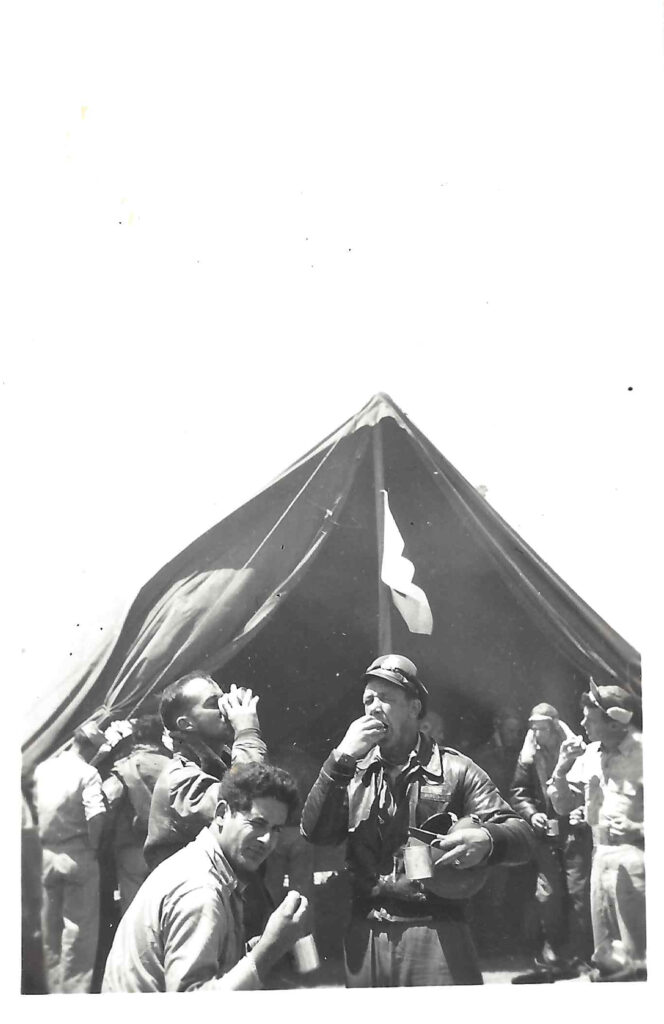
Sonny Golden Panatella and other stops 4
Pending info
The Homestretch
The month of April 1945 witnessed the successful completion of the mission of the Strategic Air Forces in the European theatre of Operations, the rapid advances of the ground forces bringing the strategic air war to a sudden close. It had been won by a decisiveness which became increasingly evident as our armies continued to overrun Germany. During the middle of the month the Squadron along with the Tactical Air Forces in close cooperation with the ground forces.
During the month 19 combat missions were flown, bringing the total to 191 since becoming operational on 5 May 1944. One airplane failed to return to base on the 190th and last effective mission flown during the war in Europe – 25 April 1945 – target, Main Station, Linz, Austria. This plane was piloted by 1st Lt. Wm. G. Shreve, Jr., a recent transfer from another group and flying his initial mission in the Squadron. He reported that he had one engine feathered and no power from a second, also that a wounded man was aboard. When last seen his plane was headed for Russian-held territory, well under control.
Returns during the month from MIA status included Sgt. Robert R. Guertin, missing since 19 July 1944, S/Sgt. Kenneth A. McMann, missing since 2 Dec 1944, and Don B. Johnson, missing since 31 Jan 1945.
On 15 April 1945, Major Growdon, our very popular Squadron Commander, left for Naples, Italy, en route to the United States, being replaced by Major David L. Jones, recently arrived from the United States.
Toward the close of the month combat personnel began to be shifted rapidly with units of the 485th Bombardment Group, indicating an early movement for that organization out of the theatre. The speedy progress of all Allied military forces indicated an early end to hostilities with a complete and unconditional surrender of the once powerful German war machine. The Squadron became non-operational in the final week of the month, despite perfect flying weather, and it was apparent to all that the last mission had been flown in this theatre of operations.
Meanwhile, beautiful spring weather brought out large numbers of men for the various sports. A baseball diamond was constructed and under the capable coaching and guidance of Cpl. Daniel C. Beal the Squadron hard-baseball team won a large percentage of its early season games, at the same time providing much needed entertainment for all members. Morale continued excellent. The Officers’ Club opened its beautiful Sunset (cocktail) Room with a vaudeville show and dance. To celebrate “one year in combat” enlisted men made plans for the “biggest show yet” for early May. PX rations, particularly beer and “coke” were increased as warmer weather approached. Living conditions on “Pantanella Heights” had reached their very peak, field conditions considered. Strength at month end: Officers, 120; enlisted men, 481.
May 1945 – the month all had been waiting for. With it came the successful end to the war in Europe. V-E Day being declared on the 8 May 1945. The mission was accomplished. The Squadron enjoyed its first holiday since coming overseas and the entire Group turned out in a fitting ceremony commemoration this important occasion. All that was now left was to “sweat out” the re-deployment of troops in Europe, including, of course, the members of the Squadron. The War Department originally had made extensive plans for an indefinite stay in Europe after the close of hostilities. A point system, known as Adjusted Service Rating, had been worked out to determine the disposition of military personnel. This system was based on the following:
Service Credit – 1 point for each month of military service. Overseas Credit – 1 point for each month of overseas service. Combat Credit – 5 points for certain awards and battle stars. Parenthood Credit – 12 points for each child under 18 (maximum 3).
A critical score of 85 points was determined as the minimum for discharge, provided personnel could be spared or replaced. Speculation became ride as to who would be discharged, who would remain in Europe to join the Army of occupation Air Force, who would be sent to thePage 22 of 25
United States for leave or furlough and further re-assignment, and who would be sent direct to the Pacific theatre of operations.
Rumors spread quickly but one seemed to persist – that the Group would be broken up and certain personnel assigned to the “Green Project,” a plan for transporting by air a certain number of troops from Europe to the United States. As the month progressed this rumor appeared to have merit when certain personnel, not essential to such a plan, were withdrawn. The entire Squadron Armament Section was transferred to the 5th Bombardment Wing, with headquarters at Foggia, Italy; our Intelligence Officers were sent to the 19th Replacement Deport near Caserta, Italy for re-assignment, POM Inspectors sent teams to assist in putting all records in final shape for an early movement.
Word was then received that three of the four groups comprising the 55th Bombardment Wing would be sent to one of the following bases: Casablanca, Dakar, Natal, Trinidad. It developed that both groups on the Pantanella Air Field – the 464th and 465th – would go to Trinidad.
The work of vacating the field increased with feverish activity. What was once a bare hill had become a bustling community of homes and buildings. Only 14 months before, the squadron had struck its tents on a bleak and stormy night. For days thereafter, all efforts were put to establish adequate living and working conditions. As months went by, permanency was established with the construction of such buildings as a Mess Hall for enlisted men, buildings for the Orderly Room, the Dispensary, Operations and Supply Sections. With the aid of Italian civilian labor, together with the resourcefulness of American personnel, these buildings and houses soon replaced the hastily put up tents. Showers were added, and in one case, a built-in cement bath tub indicated the ingenuity to which Americans were capable. Tuffa block was plentiful in southern Italy, wood being especially scarce, so that this native block was the basis for all building operations on Pantanella Air Field. During the construction period, the Squadron had erected some fifty fully-constructed homes and buildings, as well as many more tuffa-walled living quarters with tent-top roofs. Such was the picture when preparations to move were made.
The entire Air Echelon, less key personnel (Commanding Officer, Operations Officer, Squadron Navigator and Squadron Bombardier) took off on 24 May 1945 for return to the United States and further assignment. An advance ground echelon of 39 specialist from the Engineering Section was flown to the Caribbean area to set up the operation prior to arrival of the main body. On 26 May 1945, the ground echelon together with the key personnel mentioned left Pantanella by motor truck convoy for Staging Area No. 1, Bagnoli, Naples, Italy to await shipment by water to Trinidad. Thus, just a year and two months after leaving this same staging area, the Squadron was back – the job done – and personnel ready for their next assignment.
With all records, clothing, equipment, etc. all checked, there was little to do at the Staging Area except await arrival of the transport, a matter of eleven days. A liberal pass policy was put into effect and personnel given a final opportunity to do some sightseeing. Trips were made to Naples, Rome, Pompeii, Vesuvius and other nearby points of interest. The Isle of Capri held the interest of Squadron personnel and in order to permit them to visit this beautiful spot, a special
boat was chartered at Sorrento, Italy, resulting in a never-to-be-forgotten outing for all who attended.
Prior to leaving Pantanella, the Group received a second unit citation (GO No. 2139, Hq. 15 AF dated 7 Apr 1945) for its outstanding performance on the mission of 3 Aug 1944, target Manzell- Dornier Works, Friedrichshafen, Germany, the presentation being made by General Twining on 1 May 1945. Thus many members of the Squadron added an Oak Leaf Cluster to the unit citation badge they were already authorized to wear.
On 12 May 1945, Capt. John B. Harvey joined the Staff as Operations Officer, vice Capt. Dawson, relieved and returned to the United States.
Sgt. James M. Long, missing since 2 Dec 1944 returned to the Squadron on 8 May 1945. He had remained in Russian-occupied territory for five months as part of a crew flying aircraft between Ukrania and Poland. Word was received of the safety of the following personnel: Lt. Edward Paluch, missing since 3 Aug 1944; Lt. Patrick J. Logan, Lt Eugene G. Zarek, both missing since 11 Oct 1944, and S/Sgt. Leonard E. Bracken, missing since 3 Aug 1944.
Squadron strength at month end: Officers, 12; Enlisted Men, 223 (including 59 in advance echelon to Trinidad BWI).
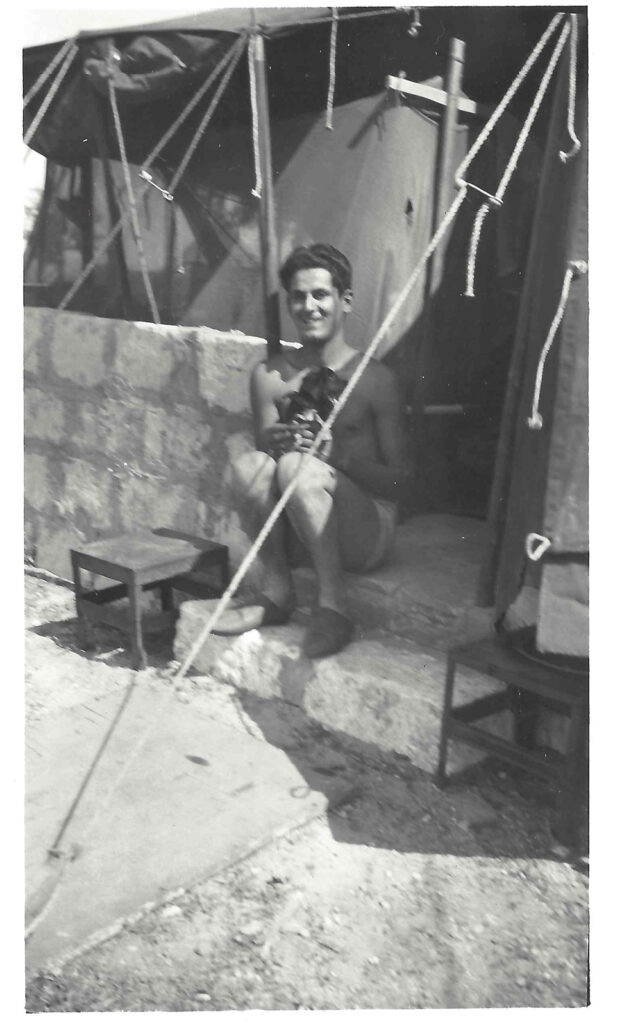
Sonny Golden Panatella and other stops 2
Pending info
A Squadron is Inactivated
The Squadron, or what was now left of it, was at the Staging Area near Naples, Italy, as the month of June opened. However, on 6 June 1945, it left Naples for Trinidad, BWI on the USS “Admiral Edward E. Eberle,” a Coast Guard troop transport. Unlike the Liberty ships which brought it overseas, the Squadron discovered the Eberle to be a brand new, clean, fast vessel featuring, among other things, excellent food, “movies,” and a loud speaker system which was employed to broadcast various announcements. No member of the Squadron who made the trip will ever forget the famed announcement: “Now hear this – Sweepers Man Your Brooms; Clean Sweep down, fore and aft.”
After a delightfully smooth crossing of nine days, the Squadron disembarked at Port of Spain on 15 June 1945, proceeding from there some twenty miles to Fort Read where personnel were billeted. The arrival was marred by the sad news of the death of two of the advance ground echelon, Cpl. Edward E. Wiggins and Pfc. Curtis L. Kline, killed in the crash of a B-24 airplane which exploded on takeoff at Dakar.
For two weeks after arrival at Fort Read, personnel went through a “screening” process before being assigned to various fields in the Caribbean area, some going to Natal, Forteleza or Belam, in Brazil; others going to Atkinson (Georgetown), British Guinea; some remaining at Waller Field, Fort Read, Trinidad, BWI; some going to Berinquen Field, Porto Rico, while some few lucky men being assigned to Morrison Field, West Palm Beach, Florida. A small staff consisting
of one officer and five enlisted men were to remain as key personnel to close the records of the Squadron prior to inactivation.
Perhaps it was somewhat of an anti-climax to be thusly broken up and be called upon to perform a non-combat job after making such an outstanding record in combat, but in the eyes of the War Department, this job was important and the personnel of the Squadron selected to do it accepted the assignment with the determination to do their level best to see that the project would be carried out successfully.
Thus ended the activities of a truly great organization – the 780th Bombardment Squadron (H). It had been exceptionally well trained and had given an excellent account of itself in both the training and combat areas. Exactly what character of an organization it was could perhaps best be described by quoting verbatim a letter received late in June 1945 from a former enlisted combat man who had completed his tour of duty and returned to the states. It read:
“This is a far cry from the life in the 780th. Like countless others, I think back to those days from time to time, forgetting the rain, mud, small beer ration and hard theatre seats, but rather remembering the pleasure that came from being among a fine group of men. To me the 780th was an ideal organization in every respect. A man was treated as such and there was a certain spirit that I’ve never found elsewhere. When I returned to this country, I was expected to dwell upon the hardships of combat. This I could not do for the greater share of my memories were those of evenings in the Enlisted Men’s and Officers’ Clubs, and above all, the friends I made over there. And so I’m afraid I disappointed many of these curious civilians who wanted to hear all about fighter attacks and walls of flak. I forgot that part of it. If your organization still exists, I would ask that you extend my personal greetings to every man and I wish all of them a speedy return to civilian life.”
Conclusion
The 465th Bombardment Group (H), which included the 780th Bombardment Squadron (H) was inactivated effective 31 July 1945 by authority of GO No. 10, Hq. 1107 AAFBU, dated 29 July 1945.